Infographics
Agile and Scrum
Key concepts related to Agile project management and Scrum, one of the agile project management techniques. (SIZE: A4)

ISA-88 Batch Processing
S88 or ANSI/ISA-88 is a standard published by the International Society of Automation (ISA) that sets out models and terminology addressing batch control. The standard was published in an attempt to standardise and thereby make it easier for automation suppliers to integrate, communicate and configure batches. It is adopted by Europe as IEC 61512-1.
A batch process is a process that leads to the production of finite quantities of material by subjecting quantities of input materials to an ordered set of processing activities over a finite period of time using one or more pieces of equipment. To describe the batch process control S88 defines three models: a) Process model: means of organisation of the processing activities that are performed by the system i.e. process. The process is achieved using the physical equipment defined in the physical model and the recipes defined in the procedural control model. b) Physical model: The physical model in the S88 standard represents the equipment and physical components involved in a process. c) Procedural control model: The procedural model in the S88 standard defines the sequential steps and actions required to execute a process. These steps form a recipe. (SIZE: A2)
Ref: ANSI/ISA-88.00.01-2010 Batch Control Part 1: Models and Terminology

Contract Types and EPC Contracts
This infographic captures some key points on the three main types of Contracts – Fixed Price, Cost Reimbursable and Time and Materials Contracts, that are covered in Project Management courses. An excellent resource for further information on project management and project contracts is the RMC Learning Solutions website. This infographic also provides an overview of the different contracts used for Engineering, Procurement and Construction (EPC) projects that are typically executed in the Energy Industry. (SIZE: A3)

Control and Instrumentation Deliverables
This infographic captures some instrumentation and control system engineering deliverables prepared by EPCs and Automation vendors for process plant projects. Note that this covers some typical deliverables and is not an exhaustive list. The deliverables will depend on the nature of the operating facility and the requirements specified by the operating company. (SIZE: A3)

Digital Transformation Technologies
Digitisation is the process of converting analogue information into digital format. In manufacturing, for instance, traditional vibration monitoring involves manual checks and analysis, which could be time-consuming and error-prone. By implementing digital vibration monitoring systems, companies can collect vibration data in real-time and make it available to maintenance engineers. However, digitisation is only the first step. The next stage – Digitalisation, involves using advanced analytics, such as machine learning algorithms, to make sense of the data and add value by identifying patterns and predicting equipment failures before they occur. This leads to more efficient maintenance processes and safer operations.
To fully realise the benefits of digitisation and digitalisation, a broader transformational process is needed. Digital Transformation involves adopting digital technologies holistically across the entire organisation to fundamentally change the way a business operates and delivers value. This can lead to new business models, products, and services that drive continuous innovation and improvement, such as developing a predictive maintenance system that uses the vibration data collected from equipment to identify potential issues and schedule maintenance proactively. This infographic also provides an overview of five popular Digital Transformation technologies that are being adopted in the Energy Industry. (SIZE: A4)

Energy Terminology
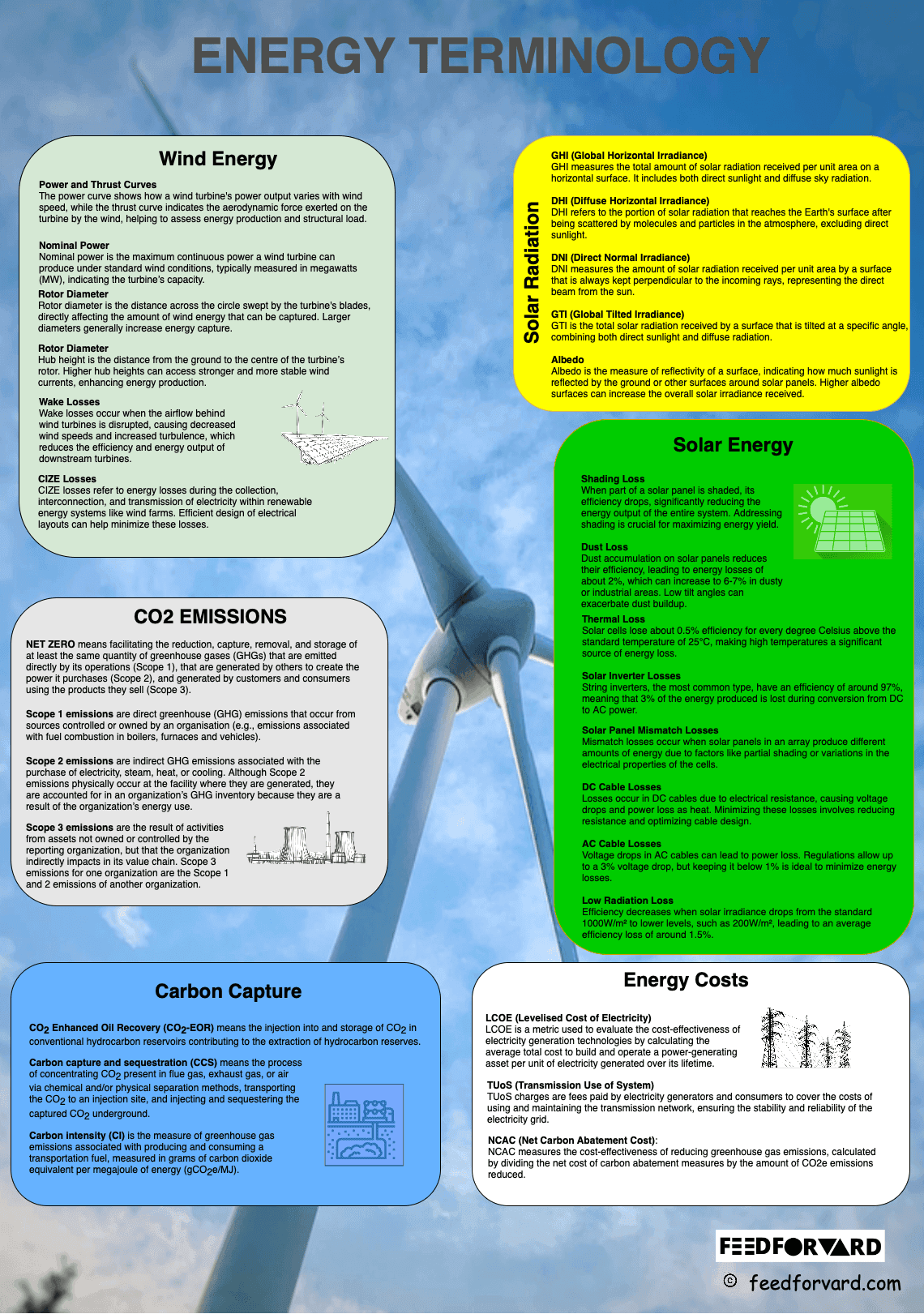
Wind and Solar energy are key renewable sources that reduce carbon emissions and enhance global energy sustainability. Various factors impact their efficiency, such as wake losses in wind farms, shading and dust losses in solar panels, and transmission losses in both systems. International agencies like the International Electrotechnical Commission (IEC) and tools like the Global Wind Atlas (GWA) provide standards and resources to help optimise energy yield, assess carbon abatement costs, and design renewable energy projects more effectively.
Carbon capture refers to the process of capturing carbon dioxide (CO2) emissions from sources like power plants and industrial processes before the emissions are released into the atmosphere. Once captured, the CO2 can either be stored underground in geological formations or utilised in various industrial applications, helping to reduce greenhouse gas emissions and mitigate climate change.
Specialised software tools are crucial to enhance the design and optimisation of systems of renewable energy. For example, WindFarmer helps in designing wind farms, PVsyst is widely used for simulating and optimising the performance of solar photovoltaic systems and for hybrid systems combining multiple energy resources, Homer Pro provides advanced modelling to optimise the integration of wind, solar, and conventional energy sources. (SIZE: A3)
IEC 62443 SECURITY LEVELS AND FOUNDATIONAL REQUIREMENTS
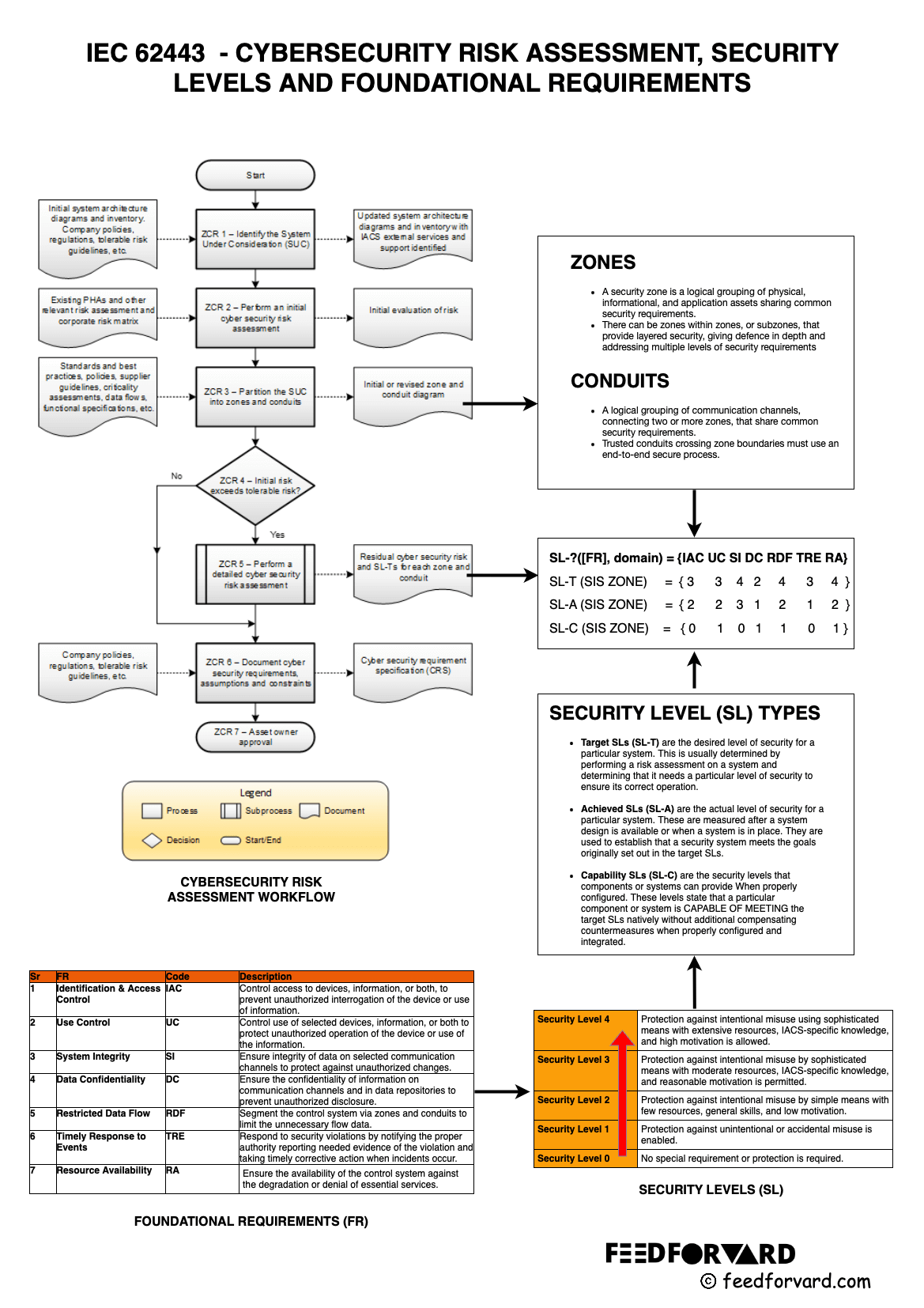
The IEC 62443 standard is a series of guidelines and requirements developed by the International Electrotechnical Commission (IEC) and aims to provide a structured approach to managing cybersecurity risk associated with industrial operational technology.
In the IEC 62443 standard, Security Levels (SLs) are defined to categorise the degree of security required by industrial control systems, ranging from SL 1, which addresses protection against accidental or low-level intentional threats, to SL 4, which is designed to defend against sophisticated and targeted attacks.
The Foundational Requirements (FRs) are a set of core cybersecurity principles and capabilities, such as identification and authentication control, data confidentiality, and system integrity, that support the achievement of these Security Levels by addressing specific types of security threats and vulnerabilities across the system’s lifecycle. (SIZE: A3)
Ref-1: How to define Zones and Conduits
Ref-2: Leveraging IEC-62443-3-2 for IACS Risk Assessments
Oil and Gas Production
This infographic provides a high-level overview of oil and gas production, covering upstream, midstream, and refining processes. It outlines onshore and offshore production methods, wellhead systems, separation and compression technologies, and gas treatment. It also details refining, petrochemical processes, and unconventional sources like shale gas and biofuels. (PDF FILE)
Prompt Patterns
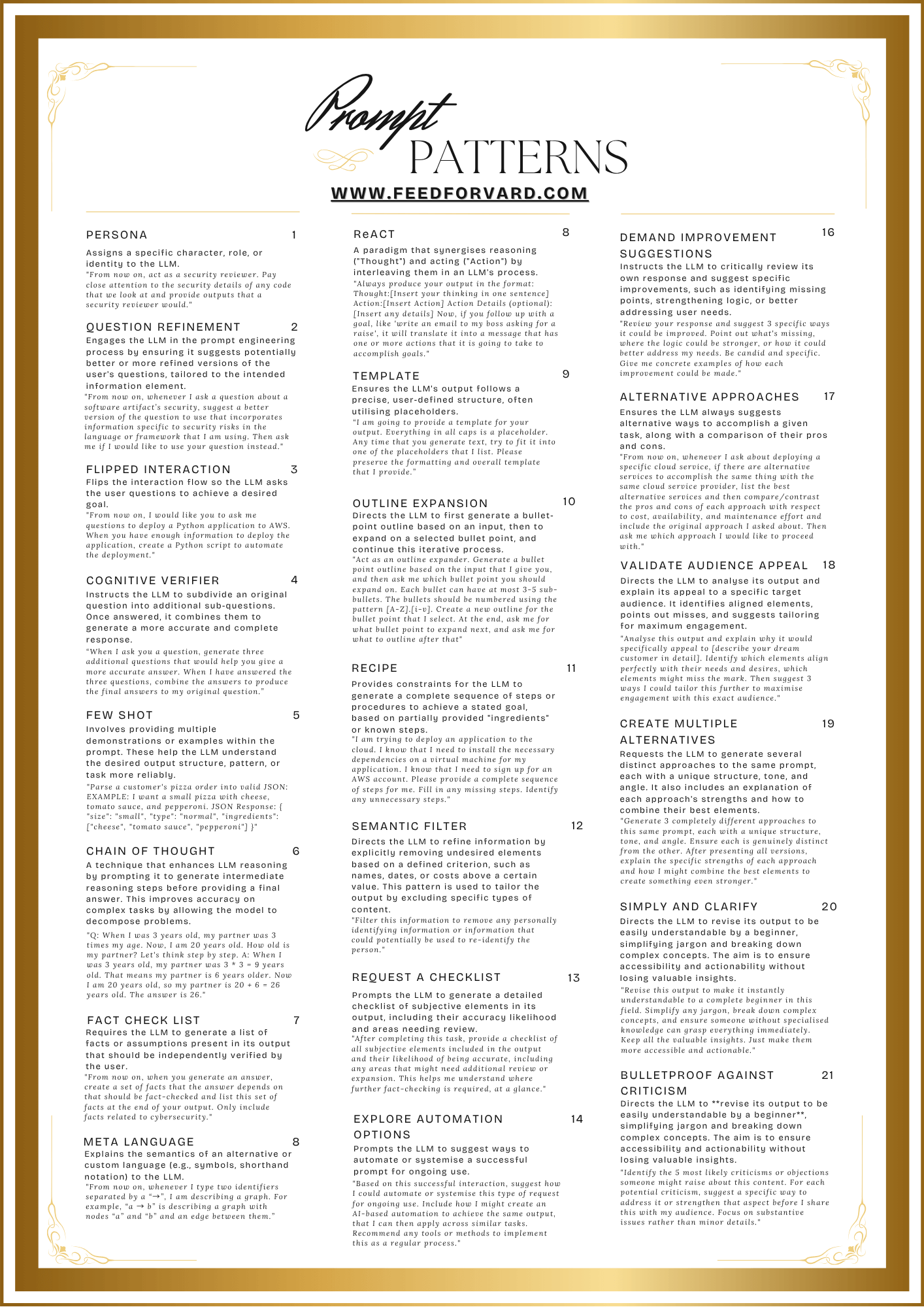
Prompt engineering is the practice of crafting effective inputs to guide the behaviour of large language models like ChatGPT. This infographic showcases 21 powerful prompt engineering patterns designed to enhance your interaction with large language models. Each pattern includes a brief description and example to help you generate clearer, more effective, and more controllable outputs.(SIZE: A3)
Ref-1: Generative AI Assistants Specialisation – Coursera
Ref-2: Prompt Engineering v4 – Google Whitepaper (January, 2025)
Ref-3: A Prompt Pattern Catalog to Enhance Prompt Engineering with ChatGPT (Vanderbilt University, 2023)
The Five Shades of Hydrogen
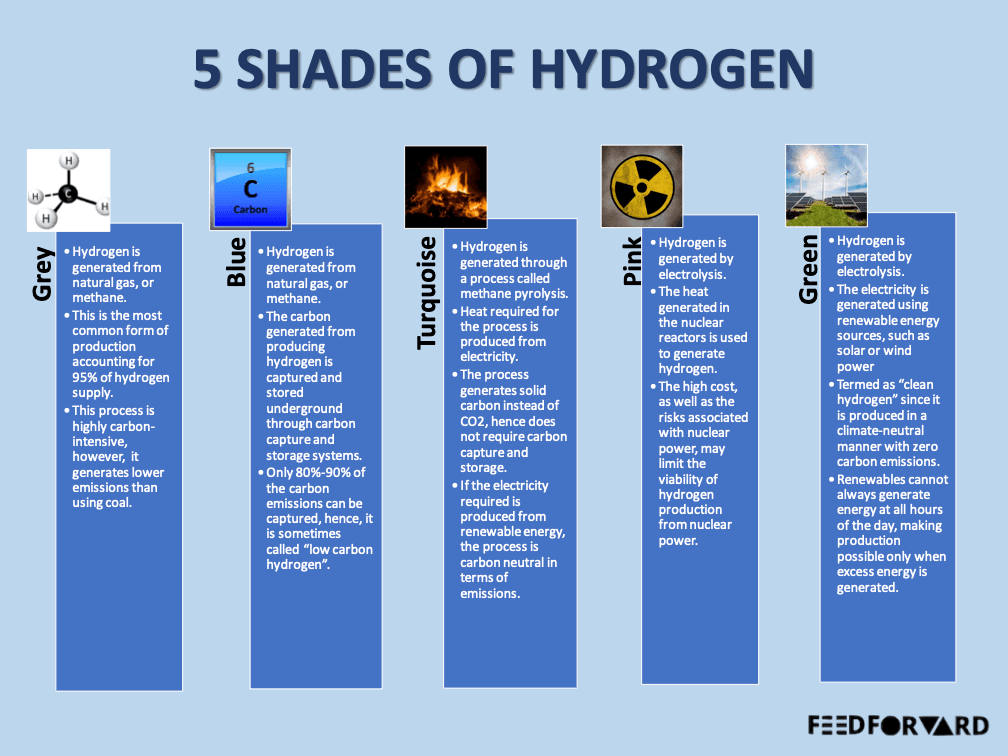
Hydrogen is the simplest and most abundant element on earth. Hydrogen is an energy carrier and not an energy source. When we burn hydrogen, the only waste product is water vapour. Hence, Hydrogen is a clean alternative to Natural Gas which produces carbon dioxide as a by-product when burnt. For Hydrogen to succeed as a clean energy source, it should be produced from renewable sources and at competitive prices. Today, depending on the different methods used to produce hydrogen, different colours are assigned to hydrogen in the energy industry. (SIZE: A3)